
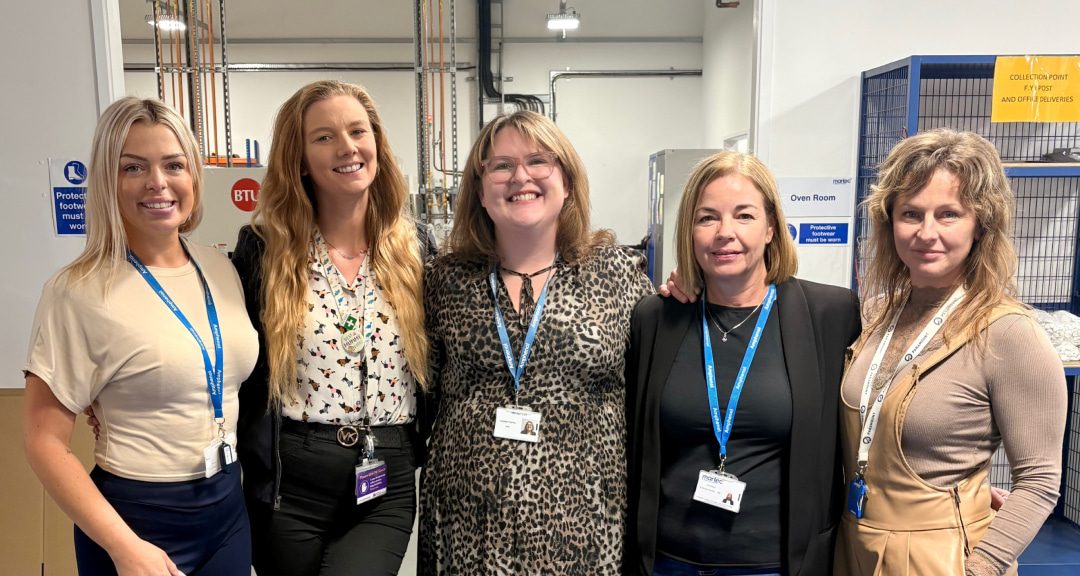
Women of Martec: Engineering Intelligence in Action, for IWIE Day 2026
This year, we are marking International Women in Engineering Day by celebrating the women of Martec. From operational roles to hands-on manufacturing, there’s no shortage of excellence within our business, and in businesses all over the world. So, to the aspiring students, to the hopeful graduates, to the seasoned engineers, this one’s for you.
Joining us: Beth Earl, Quality Engineer. Charlotte Forbister, Internal Sales Coordinator & Export Control. Jill Fielding, Internal Sales Manager. Louise Fairlie, Business Development Manager. Sabina Klimasz, Plating & Material Technologist.
What first sparked your interest in an engineering career or workplace?
Bethany: For me, both of my grandads had a profound impact on me as I was growing up. One liked to fix things rather than throwing them away, while the other was a Chief Quantity Surveyor who often worked from a drawing board.
I always knew I was interested in problem-solving and how things work. At school for A levels I picked subjects like physics, maths and product design, but it wasn’t quite the right fit for me. I moved to Canterbury College and completed an engineering course, which I absolutely loved. I was the only female on the course, but that was character building.
After that, I completed a Higher-Level Apprenticeship while working for a wheelchair passenger safety company. They sponsored me through my engineering degree, and more recently I’ve completed a Master’s degree too.
Jill: The moment I saw the Martec job description, I knew that the role was right up my street. I am sales at heart and I love a highly-detailed spreadsheet and operational approach – so while I am not an engineer, I am technical in other areas. So Martec felt like an exciting opportunity.
Engineering can seem intimidating from the outside. What is something about your role that is often misunderstood?
Louise: For a sales roles in particular, there is often a misconception that you have to know the products inside out before you apply. When I first joined the industry, I didn’t know what a semiconductor was or the difference between a semiconductor and a connector, and I wasn’t naturally technical.
Martec recognised that and were very supportive. I didn’t formally study engineering, but after years in the industry I can now comfortably hold my own in a room full of engineers. Martec supported me in building the technical knowledge and confidence required for the role.
I believe that technical companies need a wide range of skills, not just technical expertise, and it’s opportunities like mine that allow people to learn through experience.
Jill: We are a manufacturing and engineering business but there is a place here for people who are desk or process-based. It’s assumed that “engineering” means noisy tools and greasy overalls. It’s incredibly detailed, and organised. I was surprised how clean and tidy everything was!
Sabina: You obviously haven’t visited the plating shop yet!
Have you seen attitudes towards women in engineering changing during your career, and where do you think the industry needs to improve?
Beth: When I started in engineering, I found that being young and female in technical environments brought challenges, but it also motivated me to help other young women see that these careers are available to them too.
My partner is a physics teacher, and that has given me opportunities to speak to students about my experiences because it’s important they know these opportunities exist.
Louise: When I first started, it was unusual to see women in customer-facing technical roles.
I recently attended SpaceComm in London and I have definitely seen an increase in the amount of female attendees. Especially female engineering students, which is hugely encouraging.
The landscape is shifting, there’s a huge increase in the amount of organisations running programmes, such as the Women in Electronics Forum.
I would really like to see this momentum continue so we can ultimately find a path for more women to step into c-suite and board-level roles throughout the industry.
Charlotte: I’ve not experienced any gender-based preconceptions at Martec. The women here naturally support each other, but that’s because we have shared experiences or common interests, not because we’re treated differently professionally.
What advice would you give to young women or girls considering a future in STEM or product engineering?
Bethany: Do it! If you’re naturally interested in how things work, and enjoy problem-solving, don’t let stereotypes stop you. The world will always need good engineers, and the industry has a place for women who are looking for operational roles and those who want to get their hands dirty. In fact, Sabina and I compete on who can get their hands the dirtiest.
Louise: The biggest piece of advice I would give is: You don’t have to be “one of the boys.” You don’t need to change who you are to fit into engineering. You can be completely yourself. In fact, bringing different perspectives into these environments is exactly what helps them improve.
Sabina: Exactly this. Engineering needs different types of people and different ways of thinking. That’s what creates stronger teams and better solutions.
This year’s theme is “Engineering Intelligence”. What does that mean to you in the context of your role at Martec?
Jill: The technicality that I see around me on a daily basis is mind blowing. I’ve worked with a female customer who is a head of procurement and she knows everything about everything. She’s such a logical, pragmatic thinker – a superpower. She’s a great example of the strong and intelligent engineers that we have in the industry.
Bethany: For me, engineering intelligence isn’t just about engineering. It’s about recognising that every department has its own expertise. I look at what people like Charlotte do in planning, export control or finance and think, “I couldn’t do that.”
Sabina: Yes, Martec is like an engine. It is made of different modules and different parts, and those different parts need to communicate to make it all work. So departmental intelligence is important, but it’s the cross-departmental knowledge that really counts. Everyone has their own role to play. We’re all specialists in different areas, and that’s what makes the business successful.
Charlotte: Sabina is a good example of someone who is admired in her department. The men in the department are respectful of that and will often flag her as the one to go to when I need technical assistance.
Who are your female role models?
Bethany: One of my former engineering managers had a significant impact on me. She had completed a PhD in engineering and often shared stories about the challenges and bullying she’d faced earlier in her career. Compared to what she experienced, many of the barriers I encountered seemed much smaller. That resonated with me and she also encouraged me to keep going whenever things became difficult.
Louise: For me, it has to be Queen Elizabeth II – what a legend. She led with dignity, dedication and professionalism throughout her life. She was respected around the world and demonstrated what strong leadership looks like.
Charlotte: I’d choose Katie Taylor. My daughter watches her boxing matches and has now started kickboxing herself. She’s only 6 and I’m really proud of her. Having visible female role models in sport shows young girls what is possible and encourages them to try things they might not otherwise consider.
From early inspiration and career confidence to donning the overalls and cross-departmental problem-solving, the women of Martec show that engineering has room for many different kinds of thinking.
As the industry continues to change, we hope future generations of women see that there is not only a place for them in engineering, but a need for them too.